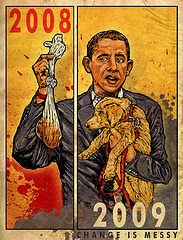
Nice!


Do you realize this will cost up to $2 Trillion dollars? For a program that has failed miserably every it has been tried? It's socialism and it will fail and it will cost generations.
Still sound good?
Indeed, The Wall Street Journal reports:
Mr. Orszag champions "comparative effectiveness research" -- studying the patterns of clinical practice to determine which drugs and treatments work best. The Administration thinks it can use such analysis to weed out wasteful or unnecessary care by paying more "if the treatment has been shown to be effective and a little less if not," as Mr. Orszag recently told the New Yorker.
The irony is that the history of post-1965 U.S. health care policy is littered with similar government attempts to control health spending, not least comparative effectiveness. The "managed care" movement of the 1990s grew directly out of the peer-review panels created by Congress in 1972 to monitor the quality and appropriateness of care for Medicare and Medicaid patients.
Under managed care, doctors and hospitals had to undergo prior "utilization review" by HMOs to reduce unnecessary hospitalizations, surgeries, tests, prescriptions and so on. This cost-effectiveness gatekeeping disciplined health spending. What happened next to this version of the dream is known to all.
Administrative hassles led to a consumer backlash, with patients feeling they were getting inferior care in return for insurer profits. The political class eventually forced the HMOs to dilute or end most of their cost-control strategies.
Democrats have now acknowledged that the managed care dream will work only if government is the one doing the managing. That is, we can only control costs with a new government entitlement. More is less.
But you can only allocate a scarce resource in two ways: market prices or brute force. In health care the brute force will come as price controls and waiting lines for rationed services. The implicit assumption in the providers' deal announced yesterday seems to be that the private companies will do the price controlling so the government won't have to do it for them.
But when the savings prove illusory, as in the past, the feds will step in and order them to do so. To win a false reprieve for themselves and give cost cover to the politicians, these private CEOs are offering to make themselves even more unpopular with patients. By that point, most patients will have no choice but to assent, since most of them will be in one government program or another.
Lest anyone remains in doubt about the ultimate goal here, Ralph Neas of the leftist National Coalition on Health Care got out a quick statement throwing ice water on the industry's concession. With perfect clarity Mr. Neas said: "Voluntary efforts -- without legislated requirements and enforcement -- have not worked well in the past."
The only benefit here is that it is now possible to see where this issue is headed: A new legislated entitlement for the middle class will ensure that the next great health-care argument to engulf the political system is going to be over how and when to ration care.
Kemp comments begin at 8:10 mark.
Fox News reports:
Jack Kemp would still be alive if the federal government had done a better job funding cancer research, Sen. Arlen Specter said Sunday, one day after Kemp, the 1996 Republican vice presidential nominee and former congressman, died of cancer.
The Pennsylvania senator, who last week switched his party affiliation from Republican to Democrat, made the claim on two Sunday shows.
On CBS' "Face the Nation," Specter suggested that one of the reasons he left the GOP was because it did not share his interest in funding medical research.
"Frankly, I was disappointed that the Republican Party didn't want me as their candidate. But as a matter of principle, I'm becoming much more comfortable with the Democrats' approach," Specter said. "And one of the items that I'm working on ... is funding for medical research. I've been the spear carrier to increase medical research."
Specter added: "If we had pursued what President Nixon declared in 1970 as the war on cancer, we would have cured many strains. I think Jack Kemp would be alive today. And that research has saved or prolonged many lives, including mine."
Specter has been treated for Hodgkin's disease, a cancer of the lymphatic system. Through his Web site, specterforthecure.com, the senator has called for more federal resources and funding to be directed toward medical research.
Specter on Sunday touted his record of increasing funding for research for the National Institutes of Health. His Web site details the strides he's made -- "doubling the nation's health research budget" and helping include funding for the NIH in the stimulus bill.
But his claims about Nixon's "war on cancer" and Kemp, the former Buffalo Bills MVP who died of an undisclosed cancer after a lengthy illness, raised eyebrows -- since the government has devoted billions to cancer research since Nixon's call in 1971 for a campaign to find a cancer cure.

President Obama launched his "bold" nationalized health-care plan today.
Just as Rahmbo The Ballerina said never let a good crisis go to waste, Obama continues to use the economic crisis as the impetus for passing his radical agenda.
It's our view, that the President is not terribly concerned with actually fixing the economy. Instead, he will use smoke and mirrors to covertly pass a radical Socialist agenda, establish a vast power grab for voting supremacy, and attempt to implode America from within.
“The cost of health care now causes a bankruptcy in America every thirty seconds," President Obama said at the White House forum on health care reform, a summit of 150 Democrats, Republicans, and advocates for doctors, nurses, patients, labor unions, and business groups. "By the end of the year, it could cause 1.5 million Americans to lose their homes.”
“If we want to create jobs and rebuild our economy, then we must address the crushing cost of health care this year, in this Administration," the President added. "Making investments in reform now, investments that will dramatically lower costs, won’t add to our budget deficits in the long-term – rather, it is one of the best ways to reduce them.”
It's ridiculous that Obama is radical, deceitful and dishonest enough to equate health-care reform with the economy and, for good measure, tie in the housing crisis. Obama is flat out lying again, but his dishonesty and hypocrisy is becoming old hat these days.
Besides the lies, he continues his strategy of doom and gloom, fear and loathing to pass his Radical Socialist agenda.
Disturbingly, Obama is allowing Congress to write the bill since they did such a bang up job on the CRAPulus Spending Bill! Nancy Pelosi is going to write national health care legislation? That's the most frightening thing I've ever heard!
We already know how pompous and narcissistic Obama is but what gives the Messiah so much confidence that after 60 years of debate, he and the Commun-O-crats in Congress have finally figured it all out?
The Christian Science Monitor reports:
In calling for comprehensive healthcare reform to be enacted by the end of the year, President Obama has set an ambitious goal – one that has eluded Congress for more than 60 years.
Past efforts at reform have been stymied by the complexity of the healthcare system, ideological differences between Republicans and Democrats, and the inability to make trade-offs between containing spiraling healthcare costs and ensuring that every American has access to healthcare.
But at Thursday's White House Forum on Health Reform, Mr. Obama declared "this time is different," saying the economic crisis has turned health reform into an imperative. He attributed the failure of past healthcare reform efforts to "special interests" who had their way over the "public interest."
"This time, the call for reform is coming from the bottom up, from all across the spectrum – from doctors, nurses and patients; unions and businesses; hospitals, healthcare providers and community groups," he said.
"This time, there is no debate about whether all Americans should have quality, affordable healthcare – the only question is, how?" he continued.
"The status quo is the one option that is not on the table," he said.
"And those who seek to block any reform at any cost will not prevail this time around."
"The only question is, how"?!?! My thoughts exactly! There is no way whatsoever Mr. Obama that "universal", "affordable", "quality" and "health care" will ever fit together! His arrogance is astounding!
And I'm so glad that unions and "community groups" will be at the bargaining table. I really hope we get to see the ACORN Anarchists!
Jake Tapper lays out the plan:
• Guaranteeing choice of health plans and physicians;
• Making health coverage affordable;
• Protecting families’ financial health;
• Investing in prevention and wellness;
• Providing portability of coverage;
• Aiming for universality;
• Improving patient safety and quality care; and
• Maintaining long-term fiscal sustainability.
Yeah, it all sounds great! But at what cost? In total, through the SCHIP Bill, the CRAPulus Spending Bill and the Obama budget plan, the Obama health care agenda already tops $1 Trillion!
But where will it end?
“The budget calls for an effort beyond this down payment, to put the nation on a path to health insurance coverage for all Americans. However, additional funding will be needed," Obama said of the $634 Billion downpayment!
That's an ass load of money for a plan that has yet to be proven to a success - anywhere in the world!
Heritage points out these flaws:
Taking Your Own Pulse: A bipartisan health care summit may be nice window dressing, but the test of real bipartisanship is found in policy, not in photo ops. So far on health care, the President’s promise for bipartisanship is more hope than change. Since January, President Obama has signed into law over $200 billion spending to advance his health care agenda—$136 billion alone on in the stimulus—with little, if any, notion of bipartisanship.
Consolidated Power: To achieve his goals, President Obama’s health plan will need to depend on a massive top-down infrastructure to control health care dollars and decisions. Instead of empowering patients and doctors, Washington will be in charge.
Loss of Private Coverage: At a time when Americans are worried about losing their health care, the promise of a new government health plan will only undermine the private health insurance that million of Americans depend on today. Not only do government programs cost more than they project, but they also promise more than they deliver.
And all of this crap to get health care that Europe has proven as a complete and utter failure!
To paraphrase Rush Limbaugh, this is exactly the sort of Socialist Legislation which I hope completely fails.As Europe demonstrates, millions go without good health care under government paid systems regularly.
According to 2004 survey only 22 percent of Spaniards think their universal care system offers “satisfactory” service. It is certainly unsatisfactory that citizens there have to wait months for a simple test like an MRI. In England, patients must wait nearly a year for hip and knee replacements.
In Spain everyone pays taxes for the universal health care system. There is, however, a select group of people who get to choose. Central government civil servants can opt-out of the public system and have the government pay for their private insurance. 91 percent of civil servants choose private insurance. That is quite an endorsement of the free market’s ability to meet consumers needs better than socialized medicine.
I'm done. I've had it with the Liberals and their blank check mentality.
Seriously, $1 Trillion for national health care that has never worked anywhere on the planet!?!
The Washington Post reports:
President Obama intends to release a budget tomorrow that creates a 10-year, $634 billion "reserve fund" to partially pay for a vast expansion of the U.S. health care system, an overhaul that many experts project will cost as much as $1 trillion over the next decade.
Obama would pay for the expansion by trimming tax breaks for the wealthy and tightening payments to insurers, hospitals and physicians, according to a senior administration official.
By first identifying a large pot of money to underwrite health care reform -- before laying out a proposal on who would be covered or how -- Obama hopes to signal his willingness to negotiate with Congress over the details of an eventual plan.
"We wanted to get this process going by putting some serious resources on the table," said the official, who was not permitted to speak on the record until formal release of the budget blueprint. "This is a reserve fund, instead of a 700-page plan. We learned the lessons of the past and want to work interactively with Congress. This is a first step."
Under the Obama budget blueprint, about half of the new "health care reserve fund" would come by limiting the tax break on itemized deductions for families with incomes above $250,000. The proposal would reduce the value of tax deductions by about 20 percent, a change which would generate about $318 billion over the next 10 years, according to administration documents provided to The Washington Post.
Throughout the campaign, Obama promised to reduce the number of uninsured Americans, improve the quality of care in the country and save the typical American family $2,500 a year in medical costs. Despite an ever-weakening economy and skyrocketing federal deficit, he has remained firm to his pledge to press ahead this year.
The budget "includes a historic commitment to comprehensive health care reform -- a downpayment on the principle that we must have quality, affordable health care for every American," the President said in his address to Congress Tuesday night. "It's a step we must take if we hope to bring down our deficit in years to come."
Republican Study Committee Chairman Tom Price (R-GA) issued the following statement after the final text of the mislabeled stimulus package was unveiled late last night.
Despite repeated calls from Republicans to eliminate provisions intended to implement a national health board tasked to determine a single standard of care, Democrats are moving forward with its creation.
“For all its faults, perhaps the most shameful provision in the non-stimulus bill is the creation of a national health care rationing board,” said Chairman Price.
“Congressional Democrats are using the cover of an economic crisis to advance an agenda that will destroy the doctor-patient relationship and set us on a course for government-administered health care. A Congress that operates in such a devious manner on such an important issue should not be entrusted with the health of American families. The American people have no interest in handing personal medical decisions over to the federal government, and we will continue to fight this bureaucratic and dangerous scheme.”
Note: The Democrats’ so-called “stimulus” package establishes a Federal Coordinating Council for Comparative Effectiveness Research (CER). This new health board lays the groundwork for a permanent government rationing board prescribing care in place of doctors and patients.
Draft report language accompanying the House version of the Appropriations health portion of the bill: “By knowing what works best and presenting this information more broadly to patients and healthcare professionals, those items, procedures, and interventions that are most effective to prevent, control, and treat health conditions will be utilized, while those that are found to be less effective and in some cases, more expensive, will no longer be prescribed.”
See Related.
House Minority Whip Eric Cantor Confirms Beginning of Nationalized Healthcare in Stimulus Bill
It's True: Even The Medical Community Is Worred About Socialized Medicine Buried In Spending "Stimulus" Bill
National Coordinator of Health Information Technology Slipped Into CRAP Stimulus; Tom Daschle's Fingerprints, Another Step Towards Socialized Medicine
Stealth Care: Sneaky Democrats Slip National Healthcare/Socialized Medicine Into Stimulus Bill
From Humane Events:
Cantor told me, “The comparative effectiveness issue has been around for quite awhile and it makes the case again that its insertion in to this bill demonstrates that the focus has not been on job sustaining and creation. This is not a job sustaining and creating provision. Some support the notion that we ought to go down the pike of allowing CMS [Centers for Medicaid and Medicare Services] now determine what kind of treatment takes place for a particular kind of patient and determine his or her doctor. That’s the kind of discussion we can have in regular order -- that’s a discussion that needs some airing -- but it doesn’t belong in a stimulus bill.”
Related:
It's True: Even The Medical Community Is Worred About Socialized Medicine Buried In Spending "Stimulus" Bill
National Coordinator of Health Information Technology Slipped Into CRAP Stimulus; Tom Daschle's Fingerprints, Another Step Towards Socialized Medicine
Stealth Care: Sneaky Democrats Slip National Healthcare/Socialized Medicine Into Stimulus Bill
Yup, it's official! Socialized National Healthcare is on its way!
Remember, the two best methods of promoting a Socialist "Stealth Care" agenda: exploit the children and blame the Republicans.
Tax cheat Tom Daschle got his wish after all, it seems.
Via Drudge Bloomberg column. Everyone missed this one! Except Betsy McCaughey. Everything you wanted to know about stealthcare but were afraid to ask.
Feb. 9 (Bloomberg) -- Republican Senators are questioning whether President Barack Obama’s stimulus bill contains the right mix of tax breaks and cash infusions to jump-start the economy.***
Tragically, no one from either party is objecting to the health provisions slipped in without discussion. These provisions reflect the handiwork of Tom Daschle, until recently the nominee to head the Health and Human Services Department.
Senators should read these provisions and vote against them because they are dangerous to your health. (Page numbers refer to H.R. 1 EH, pdf version).
The bill’s health rules will affect “every individual in the United States” (445, 454, 479). Your medical treatments will be tracked electronically by a federal system. Having electronic medical records at your fingertips, easily transferred to a hospital, is beneficial. It will help avoid duplicate tests and errors.
But the bill goes further. One new bureaucracy, the National Coordinator of Health Information Technology, will monitor treatments to make sure your doctor is doing what the federal government deems appropriate and cost effective. The goal is to reduce costs and “guide” your doctor’s decisions (442, 446). These provisions in the stimulus bill are virtually identical to what Daschle prescribed in his 2008 book, “Critical: What We Can Do About the Health-Care Crisis.” According to Daschle, doctors have to give up autonomy and “learn to operate less like solo practitioners.”
Keeping doctors informed of the newest medical findings is important, but enforcing uniformity goes too far.
New Penalties
Hospitals and doctors that are not “meaningful users” of the new system will face penalties. “Meaningful user” isn’t defined in the bill. That will be left to the HHS secretary, who will be empowered to impose “more stringent measures of meaningful use over time” (511, 518, 540-541)
What penalties will deter your doctor from going beyond the electronically delivered protocols when your condition is atypical or you need an experimental treatment? The vagueness is intentional. In his book, Daschle proposed an appointed body with vast powers to make the “tough” decisions elected politicians won’t make.
The stimulus bill does that, and calls it the Federal Coordinating Council for Comparative Effectiveness Research (190-192). The goal, Daschle’s book explained, is to slow the development and use of new medications and technologies because they are driving up costs. He praises Europeans for being more willing to accept “hopeless diagnoses” and “forgo experimental treatments,” and he chastises Americans for expecting too much from the health-care system.
Elderly Hardest Hit
Daschle says health-care reform “will not be pain free.” Seniors should be more accepting of the conditions that come with age instead of treating them. That means the elderly will bear the brunt.
Medicare now pays for treatments deemed safe and effective. The stimulus bill would change that and apply a cost- effectiveness standard set by the Federal Council (464).
The Federal Council is modeled after a U.K. board discussed in Daschle’s book. This board approves or rejects treatments using a formula that divides the cost of the treatment by the number of years the patient is likely to benefit. Treatments for younger patients are more often approved than treatments for diseases that affect the elderly, such as osteoporosis.
In 2006, a U.K. health board decreed that elderly patients with macular degeneration had to wait until they went blind in one eye before they could get a costly new drug to save the other eye. It took almost three years of public protests before the board reversed its decision.
Hidden Provisions
If the Obama administration’s economic stimulus bill passes the Senate in its current form, seniors in the U.S. will face similar rationing. Defenders of the system say that individuals benefit in younger years and sacrifice later. The stimulus bill will affect
every part of health care, from medical and nursing education, to how patients are treated and how much hospitals get paid. The bill allocates more funding for this bureaucracy than for the Army, Navy, Marines, and Air Force combined (90-92, 174-177, 181).
Hiding health legislation in a stimulus bill is intentional. Daschle supported the Clinton administration’s health-care overhaul in 1994, and attributed its failure to debate and delay. A year ago, Daschle wrote that the next president should act quickly before critics mount an opposition. “If that means attaching a health-care plan to the federal budget, so be it,” he said. “The issue is too important to be stalled by Senate protocol.”
More Scrutiny Needed
On Friday, President Obama called it “inexcusable and irresponsible” for senators to delay passing the stimulus bill. In truth, this bill needs more scrutiny.
The health-care industry is the largest employer in the U.S. It produces almost 17 percent of the nation’s gross domestic product. Yet the bill treats health care the way European governments do: as a cost problem instead of a growth industry. Imagine limiting growth and innovation in the electronics or auto industry during this downturn. This stimulus is dangerous to your health and the economy.
Remember, the two best methods of promoting a Socialist "Stealth Care" agenda: exploit the children and blame the Republicans.
From The Foundry at Heritage.org.
Dr. Steven West, president of the Florida Medical Association, notes that the economic stimulus bill contains a down payment on President Barack Obama’s plans for socialized medicine:
As Congress rushes its economic stimulus plan to the desk of President Obama, its grand vision of health reform has been secretly buried inside: rationing patient care and dispensing cookbook medicine.
That vision involves using large government bureaucracy and computer technology to tell patients what kind of care they can receive from their doctors. The congressional rationing plan will make doctors supplicants to big government and big insurance, rather than independent advocates for their patients. In the system that Congress envisions, the doctor serves the payer and not the patient.
Congress seeks $20 billion of spending on Health Information Technology (HIT) and more than $1.1 billion for Comparative Effectiveness Research (CER).…
If Americans give government and insurance companies the power to pay for care, it should come as no surprise when these third parties try to determine what they will cover and what they deem to be minimum standards of care.
.…
Scientific studies have shown that strict adherence to these best practices does not prolong patients’ lives or cure their illnesses. Worse, this committee medicine has had harmful side effects for patients. In this system, the report-card score is the most important, while patient outcomes, patient satisfaction with care and the value of medical care take a back seat.
To achieve excellence in medical care, doctors must have the flexibility to practice medicine based on the needs of each patient, not arbitrary payer formulas and thresholds. Government has displayed a dismal track record of protecting the integrity of important institutions such as our housing and banking systems.
We are not willing to blindly turn over increased control of our family’s health care to these same officials in Congress or the government.

Tom Daschle is still waiting to be confirmed as secretary of health and human services, not that he's in any rush. Democrats are already enacting his and Barack Obama's agenda of government-run health care -- entirely on the QT.
This was the real accomplishment of this week's House vote for the $819 billion "stimulus," and is the overriding theme of Congress's first month. With the nation occupied with the financial crisis, and with that crisis providing cover, Democrats have been passing provision after provision to nationalize health care.
If Democrats learned anything from the HillaryCare defeat, it was the danger of admitting to their wish to federalize the health market. Since returning to power, they've pursued a new strategy: to stealthily and incrementally expand government control. "What no one is paying attention to in the [stimulus]," says Wisconsin Rep. Paul Ryan, "is that Democrats are making a big grab at the health-care sector."
It began one week after the swearing-in, when Nancy Pelosi whipped through a big expansion of the State Children's Health Insurance Program. The Schip bill was Democrats' first stab at stealth expansion, unveiled in 2007, though vetoed by George W. Bush.
The stimulus bill working its way through Congress is not just a package of spending increases and tax cuts intended to jolt the nation out of recession. For Democrats, it is also a tool for rewriting the social contract with the poor, the uninsured and the unemployed, in ways they have long yearned to do.
As Congress rushes to inject cash into a listless economy, it is setting aside many of the restraints that have checked new domestic spending for more than a decade. The economic stimulus bill prevents states from enforcing a means test.
Republicans said this proposal would take a big step toward federalizing Medicaid. For their part, Democrats said the changes took a major step toward their goal of coverage for all Americans.