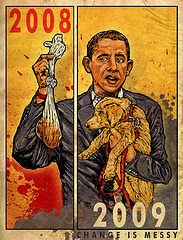
At least someone in Washington still cares about national security.


At least someone in Washington still cares about national security.

"The New York Times is a dishonest publication in business to promote a far Left point of view. They wanted Obama elected, they didn't run the story."
-- Bill O'Reilly on New Times covering up for ACORN.
O'Reilly declares war on the New York Times over the papers reaction to President Obama blocking the release of detainee abuse photos. Not surprising, they simply want to make President Bush, Dick Cheney etc. look bad simply to hurt the Republican party.
O'Reilly calls on Veteran's groups to "stand up for their comrades."
In addition, he blasts The Times for neglecting to report on connections between President Obama and ACORN.
"Clark Hoyt [New York Times Ombudsman] thinks I misled you, that is a blatant lie. Am I in the Twilight Zone here?" said O'Reilly on The Times coverup of the ACORN story.
Sen. Lieberman proposes amendment to prevent release of prisoner abuse pictures.
He wants to make it a law that pictures such as these will never be released. He and Sen. Graham wish to lead a bipartisan effort to show President Obama that he has the support of Congress on this issue.

In a sharp reversal, President Obama announced Wednesday that he will not release hundreds of photos potentially showing U.S. military personnel abusing prisoners in Iraq and Afghanistan in the aftermath of the Sept. 11, 2001, terrorist attacks.
"My belief is the publication of these photos would not add any additional benefits to our understanding of what was carried out in the past by a small number of individuals," Obama said in a brief appearance. "The most direct consequence would be to further inflame anti-American opinion and put our troops in greater danger."
Obama added that he's made it clear to military officials, however, that the abuse of detainees is "prohibited and will not be tolerated."
Obama told his legal advisers last week that he did not feel comfortable with the release of the photos because he believes they would endanger U.S. troops, and that the national security implications of such a release have not been fully presented in federal court, a senior administration official told FOX News.
The Pentagon had planned to release the photos by May 28 in response to a Freedom of Information Act lawsuit filed by the American Civil Liberties Union. That decision was made after the Justice Department lost its latest round in federal court and concluded that any further appeal probably would be fruitless.

This may be the smartest thing President Obama has done since entering office.
This may be the only smart thing he done since entering office.
I wonder how it feels to actually support the troops for a change?
Jake Tapper reports:
President Obama met with White House counsel Greg Craig and other members of the White House counsel team last week and told them that he had second thoughts about the decision to hand over photographs of detainee abuse to the ACLU, per a judge's order, and had changed his mind.
The president "believes their release would endanger our troops," a White House official says, adding that the president "believes that the national security implications of such a release have not been fully presented to the court."
At the end of that meeting, the president directed Craig to object to the immediate release of the photos on those grounds. In an Oval Office meeting with Iraq Commander General Ray Odierno, the president told him of his decision to argue against the release of the photographs.
The move is a complete 180. In a letter from the Justice Department to a federal judge on April 23, the Obama administration announced that the Pentagon would turn over 44 photographs showing detainee abuse of prisoners in Afghanistan and Iraq during the Bush administration.
The Department of Defense -- on the heels of the firestorm over the release of Bush-era memos on CIA interrogation techniques -- said Thursday it plans to make public at least 44 photos depicting potentially abusive treatment of detainees at prisons in Iraq and Afghanistan.
The decision to release the photos was announced Thursday in a letter filed in a federal court in response to a Freedom of Information Act lawsuit filed by the American Civil Liberties Union in 2004.
It sets a May 28 deadline for the Department of Defense to produce 21 images that the court in 2006 ordered the government to release and 23 additional related images, as well as "a substantial number of other images" in the Army's possession.
The images were part of the military's investigation of potential abuse of detainees by U.S. personnel at facilities other than Iraq Abu Ghraib, though the photos apparently aren't as shocking as those that set off a prisoner abuse scandal in 2004, the Los Angeles Times reports.
Even so, Defense officials say they worry that the new release of photos could set off a backlash in the Middle East against the United States, the Times reports.
The Bush administration had refused to disclose the images after the ACLU's request made in 2003, claiming that the public disclosure of such evidence would generate outrage and would violate U.S. obligations towards detainees under the Geneva Conventions.
The decision to release images comes on the same day that congressional aides said President Obama resisted pressure from Democrats to investigate Bush-era interrogation techniques, though Obama also has been under fire since last week from Republicans and former Bush advisers for releasing memos from 2002 and 2005 justifying the interrogation techniques used by the CIA.
The ACLU says making public additional images of detainee treatment is critical for helping the public understand the scope and scale of prisoner abuse as well as for
holding senior officials accountable for authorizing or permitting such abuse.
"These photographs provide visual proof that prisoner abuse by U.S. personnel was not aberrational but widespread, reaching far beyond the walls of Abu Ghraib," said Amrit Singh, staff attorney with the ACLU.